
BFF Friendship Test
DH3 GamesTrivia
4.47.40K Reviews
- Version
- 15.1.1
- Installs
- 10.00M
- Age Rating
- Everyone
Screenshots
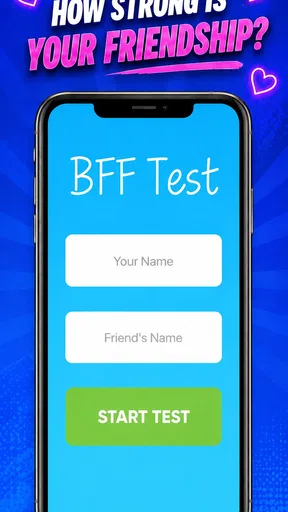
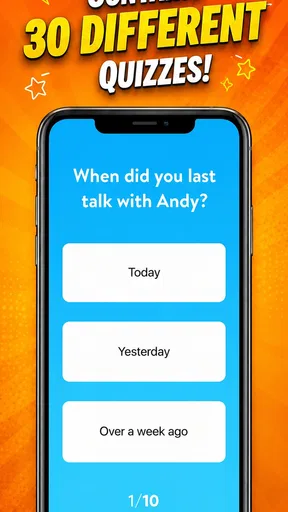
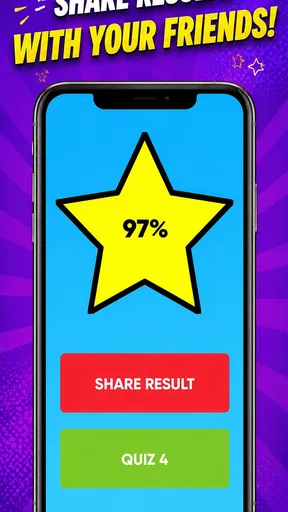
Our Review of BFF Friendship Test
 Analysis by Appyee
I like trivia games that give a group something to do without demanding a long tutorial, and BFF Friendship Test takes a very direct route. It is a free friendship quiz game from DH3 Games, built around questions that ask how well two friends know each other. The idea is simple enough to understand immediately, but the real appeal depends on how honestly players answer and how much they enjoy comparing their results.
After spending time with it, I see it less as a traditional solo game and more as a social conversation starter. You are not chasing a complex story or mastering a deep rule set. Instead, the early goal is to test your friendship, discover where your answers match, and laugh at the questions where they do not. That makes it especially suitable for a sleepover, a casual visit, a long wait, or a quick shared session when nobody wants to learn complicated rules.
The game has the broad reach you would expect from an established mobile trivia title: it has passed over ten million installs and holds an average rating of 4.4. Those figures do not guarantee that every question will suit every group, but they do suggest that the format is easy for many people to pick up. Its Everyone age rating also makes it approachable for younger players, families, and mixed-age groups, provided everyone is comfortable with the questions that appear during play.
How the friendship test creates its first goal
The strongest part of the opening experience is that the objective is immediately personal. Rather than asking me to build a character, collect equipment, or learn a fictional world, the game puts the relationship itself at the center. I want to see whether my friend knows my preferences, habits, and likely answers. That personal curiosity supplies the first reason to continue.
This is an important distinction from ordinary trivia. In a general knowledge quiz, a wrong answer usually means I missed a fact. Here, a wrong answer can become a story. If a friend chooses an answer that feels completely unlike me, the result naturally leads to an explanation, an argument, or a joke. The game works best when players treat the quiz as a prompt for conversation rather than as a serious measurement of friendship.
I would recommend agreeing on the mood before starting. If everyone wants a lighthearted activity, answer quickly and accept surprising results. If the group wants a more revealing test, take time to discuss why an answer was chosen. That small decision changes the experience considerably. The same question can be disposable in a rushed round or surprisingly useful when it opens a conversation about how two people see each other.
One practical use is to play it with a friend you have known for a while but do not often talk to deeply. The questions provide a structure, so nobody has to invent conversation topics from nothing. Another is to use it during a group gathering where some people already know one another and others are still getting comfortable. The quiz gives everyone a shared activity and can reduce the awkwardness of starting a conversation.
There is also a clear limit to this early goal: it is not a replacement for a full party game with a board, teams, or a large competitive ruleset. If your group expects strategic decisions, elaborate rounds, or a winner determined by skill, this title may feel too lightweight. Its goal is relationship-based discovery, not tactical competition.
What progress feels like when the reward is social
Progress in this game is not mainly about building a powerful profile or advancing through a long adventure. The meaningful progress signal is what players learn about one another. A strong result can confirm shared understanding, while a weak result can reveal assumptions that nobody had noticed. That makes the experience unusually dependent on the people holding the phone.
I found that the best way to keep a session interesting is to avoid treating every result as a final verdict. A friendship is not a fixed score, and people can answer differently depending on their mood or on how a question is interpreted. If the game produces an unexpected outcome, I get more value by asking, “Why did you choose that?” than by simply declaring one player right or wrong.
This is also where the game’s social design creates a useful hidden advantage. It gives quieter players a concrete way to participate. Someone who does not enjoy open-ended party conversation can still answer a question and explain a choice. In a small group, that can make the activity feel more balanced than a free-form chat where the most talkative person controls the entire evening.
For a better session, I would keep the phone visible and let both people discuss the question before locking in an answer, unless the point is to test instinct. Comparing those two approaches can itself become a mini challenge: one round can measure immediate guesses, while another can allow discussion. The game does not need complicated modes for this variation; the players can create it through the way they use the questions.
That flexibility is helpful, but it also means the app does not carry the whole experience by itself. A group that refuses to discuss answers may finish quickly and feel that there was little to do. The title provides the prompts, while the players provide the energy, interpretation, and replay value.
Difficulty, fairness, and the shape of the challenge
The difficulty is personal rather than academic. There is no useful advantage in being good at geography, mathematics, or memorizing facts if you do not know the friend being tested. Someone who has spent years with a person may perform better than someone with stronger general trivia knowledge. That makes the challenge feel appropriate for the theme, although it can also make results uneven when the players have different levels of familiarity.
New friends may find the test more difficult simply because they have fewer shared experiences. I do not see that as a flaw, but it is worth understanding before treating the result seriously. A low score may say more about how recently two people met than about the quality of their friendship. Likewise, a high score might come from predictable habits rather than deep emotional understanding.
The difficulty curve is therefore shaped by context. With close friends, the questions can become a test of memory and observation. With newer acquaintances, they work better as guesses that lead to conversation. With family members, the experience may expose generational differences in taste and assumptions. The same quiz can feel easy, awkward, or revealing depending on who is playing.
I would skip the game for groups that are likely to use incorrect answers as ammunition. Even a harmless question can become uncomfortable if someone is sensitive about being misunderstood or if the group turns the score into a judgment. The Everyone rating makes the game broadly accessible, but age suitability does not automatically mean every social situation is suitable. A little awareness of the group matters more than the label.
Another trade-off is that personal questions do not always have one obvious interpretation. A player may choose an answer based on what they want, what they usually do, or what they did recently. Before arguing about a result, I recommend asking which interpretation the player had in mind. That habit prevents the game from becoming a pointless dispute and turns ambiguity into another opportunity to learn something.
Pacing and the pressure to keep playing
The pacing is naturally quick because each question has a built-in reason to answer: I want to know whether my friend gets me right. That curiosity can carry the opening part of a session without the need for a complicated reward structure. A few questions can fill a short break, while a larger group can extend the activity by discussing unexpected answers.
At the same time, the game’s retention pressure is mostly social rather than mechanical. I am not returning because I need to protect a long streak or complete a demanding upgrade path. I return when there is another friend to test, another relationship to compare, or another occasion where a conversation starter would help. That makes it easy to recommend casually, but it also limits its appeal as a daily solo habit.
This is the central pacing trade-off. The lack of heavy systems keeps the game accessible and prevents the session from feeling like work. However, players who want visible long-term progression may find the experience thin. The title does not replace an ongoing trivia challenge with extensive personal goals, and it should not be judged as though it were designed to do so.
For a more satisfying session, I would avoid trying to complete everything in one sitting. Use it as an activity between conversations rather than as the only event. For example, during a gathering, play a few questions, talk about the surprising answers, then return to it later with another friend. This approach makes the short-form pacing feel intentional instead of making the game seem too brief.
The current version is 15.1.1, and the game supports devices running Android 6.0 or later. That makes it usable on a wide range of Android phones, including older devices that may not run newer games comfortably. I still suggest checking that the phone is ready for shared use before starting: a low battery, a crowded screen, or players passing the device awkwardly can interrupt the social rhythm more than the quiz itself.
Who gets the most from the format
This is a good fit for best friends who enjoy playful disagreements, siblings who want to compare how well they know each other, and couples or small groups looking for easy prompts. It also suits people who prefer a short activity over a long game night. Because the central challenge is recognition rather than specialist knowledge, players with very different interests can participate on relatively equal terms.
I especially like it for situations where attention is divided. During a casual visit, nobody has to commit to a forty-minute rules explanation. During travel or a waiting period, a few questions can provide entertainment without requiring a table, cards, or a large setup. The free price removes another barrier for someone who wants to try it spontaneously rather than plan a purchase in advance.
It is less suitable for a person who wants a private solo experience. Even if someone can open the game alone, the main point depends on another person’s answers and reactions. It is also not the best pick for players who need a clear skill ladder, extensive unlocks, or a competitive ranking system to stay interested. A conventional trivia app with factual categories would be a better choice for someone who wants to improve knowledge or track personal performance.
Compared with paper friendship questionnaires, the phone-based format is faster to start and easier to use when no one has prepared materials. Compared with a general quiz game, it is more personal but less useful for testing broad knowledge. Compared with a large party title, it needs less equipment and fewer rules, but it offers less structure for a big group. Those differences make the choice fairly clear: select this game for relationship-focused interaction, not for a deep competitive framework.
The developer, DH3 Games, has positioned the experience around a very understandable social premise, and the large install base shows that the premise travels well. Still, popularity should not be confused with universal replay value. The game’s longevity depends on whether your group enjoys revisiting the same kind of interaction with different people and whether the questions continue to produce interesting discussions.
Small habits that improve the experience
My first tip is to separate “knowing” from “agreeing.” A friend may correctly predict what I would choose without sharing that preference themselves. Discussing that difference creates better conversation than simply celebrating a matching answer. It also prevents the score from becoming a shallow measure of similarity.
My second tip is to use the game as a warm-up, not a verdict. Start with people who already feel comfortable together, then invite newer friends once the group understands that surprising results are part of the fun. This reduces the chance that an early mismatch will feel embarrassing or overly serious.
My third tip is to change the answering rhythm. Fast answers test instinct, while a short discussion tests how well players can explain their view of one another. Switching between these approaches gives the session more texture without pretending that the app includes a complicated set of modes. It is a simple player-created challenge that makes the available questions work harder.
Finally, I would stop when the conversation starts repeating itself. Because the game relies on social energy, continuing past that point can make it feel less enjoyable. A short, lively session is better than forcing a complete run simply because the phone is still in hand.
My verdict on the progression and replay value
BFF Friendship Test succeeds when I judge it as a lightweight social trivia game. Its early goal is clear, its challenge is easy to understand, and its pacing makes it convenient for real-life situations. The strongest progress signal is not a complicated unlock path but the changing picture of how well friends understand one another. That is enough to support a fun session, especially when players explain their answers instead of treating the result as absolute.
Its weakness is equally clear: the game does not offer the depth that keeps a dedicated solo player engaged for weeks. The retention loop depends on new people, new conversations, and the willingness to interpret results playfully. If those ingredients are missing, the experience can feel short and repetitive. That is not a reason to reject it; it is a reason to choose it for the right occasion.
I would recommend it to anyone wanting a free, approachable way to break the ice or test a friendship without preparing a full party game. I would skip it in favor of a conventional trivia title if my priority were factual learning, detailed statistics, or a demanding progression system. The best way to play is to treat the score as a conversation starter, not a final judgment about the friendship.
For its intended audience, that balance works. The game is easy to start, friendly enough for an Everyone-rated audience, and flexible enough to fit a quick break or a longer gathering. It does not need elaborate goals to be useful. When the right people are sharing the phone, its simple questions can create the very thing many mobile games struggle to provide: a reason to look up from the screen and talk.
Verdict
Strengths of BFF Friendship Test
- Quick, entertaining quizzes for comparing friendship compatibility.
- Simple interface that is easy for younger users to navigate.
- Results can be shared with friends for extra social fun.
- Offers a lighthearted way to start conversations with your best friend.
- Works well for short play sessions without a complicated setup.
Limitations of BFF Friendship Test
- Results are for fun and do not accurately measure a real friendship.
- Some questions may feel repetitive after several rounds.
- Sharing results may create awkward moments or friendly disagreements.
- Limited depth may reduce replay value for older users.
- May include ads or optional purchases depending on the app version.
Other Releases by DH3 Games
View All
How Well Do You Know Me?
Trivia4.4
Similar Picks in This Category
View All
Millionaire 2026 Quiz & Trivia
Quiz & Trivia Games by Submarine Apps4.5

Brain Test 2: Tricky Stories
Unico Studio4.7

Trivia Crack: Brain Quiz Games
etermax4.4

QuizzLand. Quiz & Trivia game
Quiz & Trivia Games by Mno Go Apps4.8

Brain Test: Tricky Puzzles
Unico Studio4.7

Logo Quiz
bubble quiz games4.5
Frequently Asked Questions
What is BFF Friendship Test and how does it work?
BFF Friendship Test is a casual quiz app designed to compare how well friends know each other. You typically answer questions about preferences, habits, memories, and personality, then invite a friend to complete the same or related questions. The app compares the responses and presents a compatibility or friendship score for entertainment rather than as a scientific measurement.
Is BFF Friendship Test free to download and use?
The app can generally be downloaded for free, but some versions may include advertising, optional in-app purchases, or premium features. Depending on the release and your device, certain question packs, customization options, or ad-free tools may require payment. Check the store listing carefully before downloading, especially the in-app purchase section, because pricing and available features can change.
Does BFF Friendship Test require an internet connection?
Basic quizzes may work without a constant internet connection, but online features can depend on access to the internet. Sharing results, inviting friends through links, loading advertisements, synchronizing answers, or using social functions may require mobile data or Wi-Fi. If you plan to play together, it is best to keep the app updated and use a stable connection.
Can I share my BFF Friendship Test results with friends?
Most friendship-test apps are designed to make sharing part of the experience. After completing a quiz, you may be able to send an invitation or result through messaging and social media applications. Before sharing, review the displayed answers and score, since the result could reveal personal preferences or private responses that you may not want everyone in your contacts or social audience to see.
Is the BFF Friendship Test score accurate or scientifically reliable?
The score should be treated as a fun estimate rather than a psychological assessment or objective measure of friendship. Results depend on the questions included, how honestly each person answers, and how the app calculates matching responses. A low score does not mean a friendship is weak, just as a high score does not prove complete compatibility. Use it as a conversation starter and entertainment.
Play our best games!


